
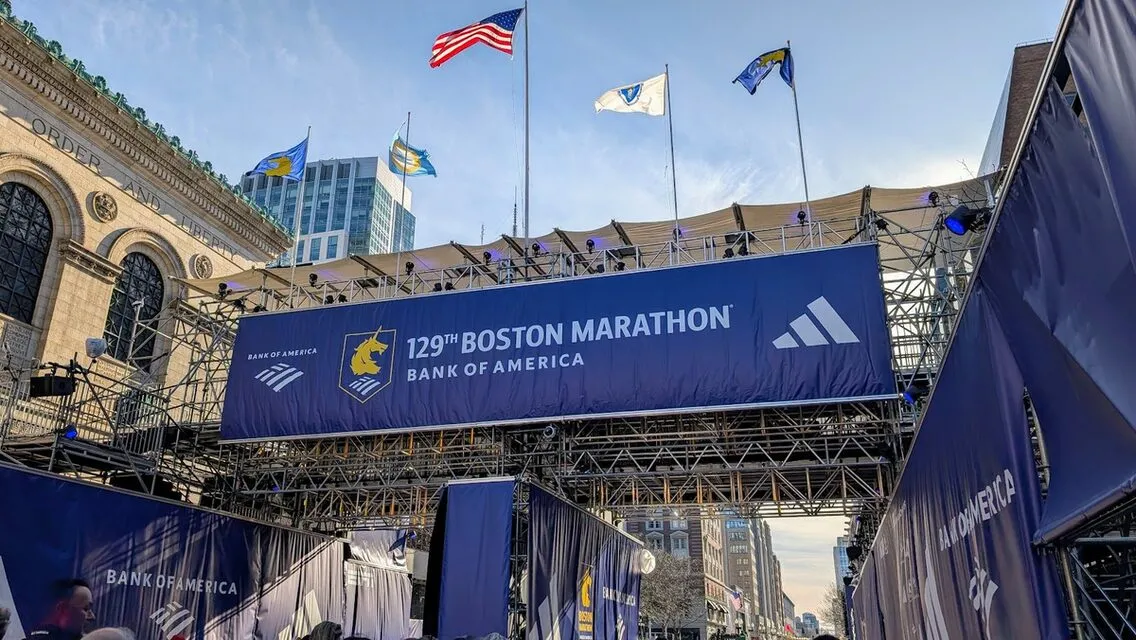

The Boston Marathon is run on Patriots' Day, the third Monday in April, and the 131st edition is set for Monday, April 19, 2027, according to the Boston Athletic Association (B.A.A.), which organizes it. The race is point to point: 26.2 miles from Main Street in Hopkinton to Boylston Street near the Boston Public Library in Copley Square, through eight cities and towns, with a field set at 30,000 official entrants. Details below come from the B.A.A., the MBTA and the City of Boston, checked October 7, 2026. The 2027 schedule, closures and transit plan are not published yet, so the 2026 arrangements are shown as a guide.
When is the 2027 Boston Marathon?
Patriots' Day has fallen on the third Monday in April since 1969, so the date moves each year. In 2026 the weekend also brought the B.A.A. 5K and Invitational Mile on Saturday, a Fan Fest on City Hall Plaza from Friday to Sunday, and the City's Patriots' Day Parade on Monday morning. The Boston Marathon Expo is held at the Hynes Convention Center in Back Bay.
The start is staggered by division over more than five hours. These were the 2026 start times in Hopkinton; the B.A.A. says start times are subject to change.
| Division | 2026 start time |
|---|---|
| Military marchers | 6:00 a.m. |
| Wheelchair Division, men | 9:06 a.m. |
| Wheelchair Division, women | 9:09 a.m. |
| Handcycles and duo teams | 9:30 a.m. |
| Professional men | 9:37 a.m. |
| Professional women | 9:47 a.m. |
| Para Athletics Division | 9:50 a.m. |
| Waves 1 to 6 | 10:00, 10:15, 10:28, 10:41, 11:01 and 11:21 a.m. |
In 2026 the B.A.A. said the finish line would close at 5:30 p.m. If you want to see the winners, plan around the leaders: the B.A.A.'s 2026 guide estimated the first wheelchair racers at the finish about 10:21 a.m., the professional men about 11:40 a.m. and the professional women about 12:04 p.m.
The course: eight cities and towns, Hopkinton to Boylston Street
The route follows Route 135 through Ashland, Framingham, Natick and Wellesley, then Route 16 and Commonwealth Avenue through the Newton hills, Chestnut Hill Avenue to Cleveland Circle, and Beacon Street through Brookline and Kenmore Square, before turning onto Hereford Street and Boylston Street. Only the last mile and a half are in the City of Boston, plus a short stretch along Chestnut Hill Avenue to Cleveland Circle. Newton and Brookline are separate municipalities, not Boston neighborhoods, and Hopkinton, where the race starts, is a separate town well west of the city.
| Town | Miles | Commuter Rail or T stops (B.A.A.) | 2026 road closures |
|---|---|---|---|
| Hopkinton | Start to 1.90 | No station listed; limited spectator parking at Hopkinton State Park, with shuttles | 7:00 a.m. to 1:30 p.m. |
| Ashland | 1.90 to 4.95 | Ashland (Commuter Rail), just under a mile from the course | 7:00 a.m. to 1:45 p.m. |
| Framingham | 4.95 to 7.52 | Framingham (Commuter Rail), Waverly Street | 7:45 a.m. to 2:15 p.m. |
| Natick | 7.52 to 11.72 | West Natick and Natick Center (Commuter Rail) | 8:30 a.m. to 3:00 p.m. |
| Wellesley | 11.72 to 15.93 | Wellesley Square, Wellesley Hills, Wellesley Farms (Commuter Rail) | 8:30 a.m. to 4:15 p.m. |
| Newton | 15.93 to 21.35 | Green Line, including Woodland and Boston College | 8:00 a.m. to 5:30 p.m. |
| Boston (Chestnut Hill Avenue) | 21.35 to 22.45 | Green Line | 9:00 a.m. to 7:00 p.m. |
| Brookline | 22.45 to 24.70 | Green Line C branch, including Cleveland Circle | 9:00 a.m. to 6:00 p.m. |
| Boston (Kenmore to the finish) | 24.70 to 26.20 | Commuter Rail, Green Line and Orange Line | 9:00 a.m. to 7:00 p.m. |
Where to watch the Boston Marathon
The course runs one way, so plan ahead if you want to see a runner twice. The free B.A.A. Racing App tracks participants at checkpoints, and closure times above are B.A.A. estimates that can shift.
The start in Hopkinton. The race has started on Main Street since 1924. There is no T service; spectator parking at Hopkinton State Park is limited, and roads close around 7:00 a.m.
Framingham and Natick. The B.A.A. names the Framingham Train Depot, at about mile 6.5, as a spot to watch runners pass and then take an inbound Commuter Rail train to Boston. In Natick, crowds gather by Fisk Pond and on Natick Common.
Wellesley. Just before halfway, the course passes Wellesley College and what the B.A.A. calls the Wellesley Scream Tunnel. Three Commuter Rail stations serve the town. The B.A.A. and the Doug Flutie, Jr. Foundation for Autism also run a sensory-friendly viewing area around mile 13.5 at the Tolles Parsons Center, 500 Washington Street, which asks guests to RSVP and skip noisemakers.
Newton and Heartbreak Hill. The Newton hills run from about mile 17.5 to mile 21, and the B.A.A. marks the crest of Heartbreak Hill at mile 20.8, near Boston College; the Johnny Kelley "Young at Heart" statue stands at mile 19.2. The Green Line's Woodland and Boston College stops bring you close. In 2026 the B.A.A. estimated the professional men would reach Boston College about 11:10 a.m. and the professional women about 11:32 a.m.
Brookline and Beacon Street. From Cleveland Circle the course follows Beacon Street through Brookline for nearly three miles, with Green Line C branch stops alongside. In 2026 the MBTA closed the above-ground Kent Street and St. Mary's Street stops on the C branch, and South Street on the B branch, from about 10 a.m. to 6 p.m.
Kenmore Square and the finish. The CITGO sign in Kenmore Square marks mile 25.2 and the "1 mile to go" point. From there runners dip under Massachusetts Avenue, turn onto Hereford Street and then onto Boylston Street. The B.A.A. lists ADA-accessible viewing near the finish at the corners of Boylston with Hereford Street, Ring Road, Fairfield Street and Exeter Street. If you are meeting a runner, plan for the Family Meeting Area on Stuart Street between Berkeley and Clarendon streets, which has alphabetical signs; the B.A.A. warns it takes considerable time for runners to get there from the finish.
Getting around on Marathon Monday
The City of Boston urges visitors not to drive, and the B.A.A. says spectators will not be able to park near the finish. The T is the plan. In 2026 the MBTA made these changes:
| What | 2026 arrangement (MBTA) |
|---|---|
| Copley station | Closed all day. Use Arlington (all Green Line branches), Prudential (E branch), Hynes Convention Center (B, C and D branches) or Back Bay (Orange Line). |
| Green Line surface stops | South Street, Kent Street and St. Mary's Street closed about 10 a.m. to 6 p.m. |
| Subway | Red, Orange, Green, Blue and Silver lines on a weekday schedule; service starts around 5 a.m. |
| Commuter Rail | Framingham/Worcester Line on a special schedule with extra trips and coaches; other lines on a weekday schedule. A $10 Holiday Weekend Pass covered all lines and zones over the holiday weekend, but not the subway or bus. |
| Buses | Saturday schedule with many detours; routes 55 and 65 suspended; route 1 as often as every 5 minutes from 9 a.m. to 9 p.m. |
| Bikes | Not allowed on the subway all day, or on the Framingham/Worcester Line from 5 p.m. Sunday to the end of service Monday. |
The B.A.A. notes that Hynes Convention Center station is not ADA accessible. If you must drive in, the B.A.A. suggests the garage at 100 Clarendon, Prudential Center parking on Huntington Avenue, or Copley Place; the Boston Common Garage is closed on Marathon Monday morning. For fares and lines, see our visitor's guide to the T.
In Boston itself, the City's 2026 advisory put parking restrictions on Back Bay streets from the weekend before the race, closed Newbury Street and Huntington Avenue outbound to traffic on race day to give spectators room, and restricted Beacon Street in Brighton from Chestnut Hill Avenue to the Brookline line. Read posted signs; the City can change restrictions.
Bags, drones and what to leave behind
The B.A.A.'s 2026 prohibited-items list for spectators covered backpacks and over-the-shoulder bags including handbags; packages larger than 12 by 12 by 6 inches; glass, cans and any container holding more than a liter; large blankets and sleeping bags; coolers; suitcases; costumes that cover the face or extend well beyond the body; props such as sporting equipment and flagpoles; weapons; and fireworks or flammable liquids. Its spectator guidelines add that bicycles, scooters and strollers are not permitted on the course, nothing may be thrown onto it (confetti, streamers, bubbles and bottles included), and drones are prohibited along the entire route.
The City of Boston's 2026 guidance was softer: backpacks and strollers are not banned, but people carrying them may be searched. The Boston Police Department said public drinking and marijuana use are not permitted, and that only credentialed runners and staff may be on the course until streets reopen. Alcohol is not allowed on MBTA trains, buses or stations either.
Where to stay for the marathon
Back Bay puts you closest to the finish, the Expo at the Hynes and the Family Meeting Area, but it is also inside the closure zone: the City's advisory restricts parking and traffic on Boylston, Newbury, Clarendon, Dartmouth, Exeter and neighboring streets over race weekend, so arriving by car or taxi is awkward. Kenmore Square and Fenway sit at mile 25 and on the Green Line. Either way, book early, because the race lands on a holiday weekend. See things to do in Back Bay, hotels near Kenmore Square and things to do in Fenway. For the rest of April, see things to do in Boston in the spring, our Boston events calendar, sports things to do in Boston and the best time to visit Boston.
Search hotels in Back Bay on Expedia
BostonVacay earns a commission if you book through this link, at no extra cost to you.
How runners get in: qualifying and charity entries
Most of the field qualifies. Runners must post a qualifying time for their age and gender at a certified marathon, then apply during a registration week in September; those furthest under their standard are accepted. For 2027 the B.A.A. received 33,649 qualifier applications. Runners at least 5 minutes 17 seconds faster than their standard were accepted, 24,630 of them, and, new for 2027, about 1,000 qualifiers slower than that cut-off were picked at random. Runners must be at least 18 on race day.
The rest of the 30,000 are invitational entries: professional and Para athletes, and charity runners. The Bank of America Boston Marathon Official Charity Program makes up almost 10 percent of the field; 215 nonprofits were selected for 2027, and the program raised a record $57.3 million in 2026. Charities take applications directly, from the fall. Qualifier registration for 2027 is closed, and the B.A.A. says details for 2028 will follow the April race.
A short history
The B.A.A. calls it the world's oldest annual marathon. Inspired by the marathon at the 1896 Athens Olympics, B.A.A. member John Graham organized a 24.5-mile race from Metcalf's Mill in Ashland to the Irvington Oval in Boston. On April 19, 1897, John J. McDermott won it from a starting field of 15 in 2:55:10. The start moved to Hopkinton in 1924, when the course was lengthened to the Olympic distance.
Roberta "Bobbi" Gibb ran in 1966 without a number, joining the field in Hopkinton and finishing in 3:21:40, the first woman to run the race. In 1967 Kathrine Switzer, entered as "K. V. Switzer," became the first woman to run with a bib number. Women were officially allowed to enter in 1972, and in 1975 Bob Hall became the first official wheelchair finisher, in 2:58. In 2013 two explosions on the final stretch of Boylston Street turned the day into a tragedy, and "Boston Strong" became the city's response. The current course records are 2:01:52 for men, by John Korir, and 2:17:22 for women, by Sharon Lokedi.
Sources: B.A.A. Info for Spectators, B.A.A. 2026 Course Map and Spectator Guide, B.A.A. prohibited items, B.A.A. spectator guidelines, B.A.A. 2027 acceptance figures, B.A.A. qualifying, B.A.A. 2027 charity program, B.A.A. history, MBTA Boston Marathon Guide, MBTA 2026 service announcement, City of Boston 2026 traffic advisory, City of Boston 2026 marathon preparations. Checked October 7, 2026.