The Public Garden
About
The Public Garden was established in 1837 as the first public botanical garden in America, and it was built for strolling rather than crossing town. Where Boston Common next door began as pasture, the Garden was filled marshland laid out in the 1860s to a competition-winning plan by George F. Meacham, whose serpentine lagoon and winding paths still shape it. Its 24 acres between Charles and Arlington streets were set aside for public use forever in 1859, and the city's Parks Department still beds the paths with Victorian-style displays grown in its own greenhouses, more than 80 species in all.
It suits a slow hour with children who know Make Way for Ducklings, anyone who likes flowers and sculpture, and a first visit that ends a Freedom Trail morning somewhere quieter. Arlington station on the Green Line is across the street from the Garden's entrance at Arlington and Boylston streets; the Swan Boats put the walk from there to their dock at about four minutes. Park Street and Boylston stations on the far side of the Common also serve it.
The lagoon and the Swan Boats
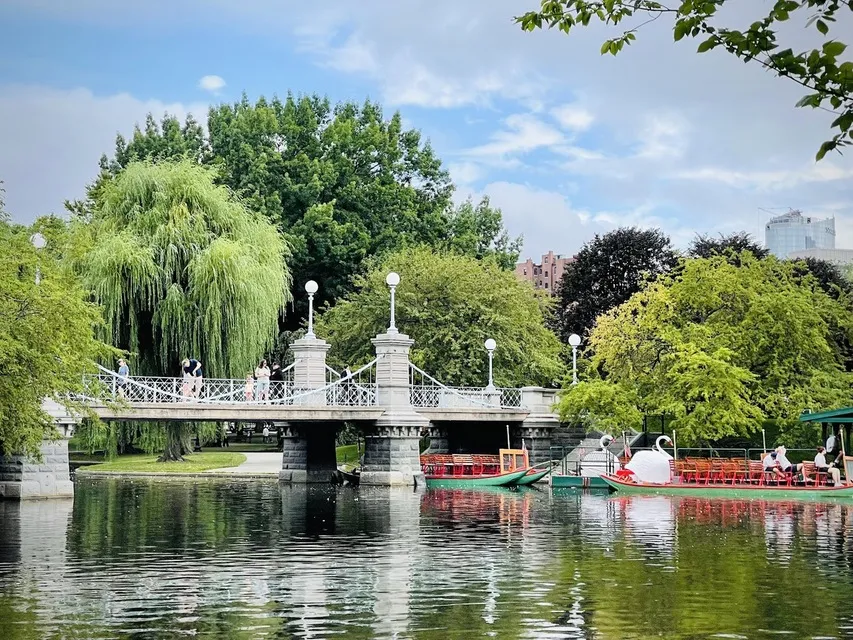
The Swan Boats, designed by Robert Paget, first appeared on the lagoon in 1877 and are still run by his family. A driver pedals each boat while passengers sit on six benches, and a ride lasts 10 to 15 minutes. The 2026 season ran from April 18 to September 7; the boats are now closed until April 2027. The footbridge over the lagoon, designed by William G. Preston, dates from the 1860s.
Sculpture and memorials
The oldest monument is the 1868 Ether Monument, honoring the first use of ether as an anesthetic at Massachusetts General Hospital in 1846. Thomas Ball's equestrian George Washington was unveiled on July 3, 1869, and the horse was modeled on a local charger named Black Prince. At the corner of Beacon and Charles streets, Nancy Schön's bronze Mrs. Mallard and her eight ducklings, based on Robert McCloskey's 1941 book, have been in the Garden since 1987. Near the Beacon and Arlington corner, the George Robert White Memorial of 1924 was the last collaboration of Daniel Chester French and Henry Bacon.
Free garden tours
Volunteer guides from the Friends of the Public Garden lead free one-hour walks on the Garden's history, sculpture and plants, meeting at the Ducklings. No sign-up is needed for the regular tours; the schedule is in the FAQ.
Before you go
No food is sold in the Garden, and feeding the birds is restricted to protect the wildlife and the lagoon. The nearest public restrooms are on the Common, at the visitor information center and seasonally at the Frog Pond.
Sources: City of Boston: Public Garden, Friends of the Public Garden: the Garden, Public Garden tours, park FAQ, hours and directions, Swan Boats. Checked September 27, 2026.
Contact Information
Boston, 02116
Photo: Nolan Camejo via Google
The Public Garden
About The Public Garden
The Public Garden was established in 1837 as the first public botanical garden in America, and it was built for strolling rather than crossing town. Where Boston Common next door began as pasture, the Garden was filled marshland laid out in the 1860s to a competition-winning plan by George F. Meacham, whose serpentine lagoon and winding paths still shape it. Its 24 acres between Charles and Arlington streets were set aside for public use forever in 1859, and the city's Parks Department still beds the paths with Victorian-style displays grown in its own greenhouses, more than 80 species in all.
It suits a slow hour with children who know Make Way for Ducklings, anyone who likes flowers and sculpture, and a first visit that ends a Freedom Trail morning somewhere quieter. Arlington station on the Green Line is across the street from the Garden's entrance at Arlington and Boylston streets; the Swan Boats put the walk from there to their dock at about four minutes. Park Street and Boylston stations on the far side of the Common also serve it.
The lagoon and the Swan Boats
The Swan Boats, designed by Robert Paget, first appeared on the lagoon in 1877 and are still run by his family. A driver pedals each boat while passengers sit on six benches, and a ride lasts 10 to 15 minutes. The 2026 season ran from April 18 to September 7; the boats are now closed until April 2027. The footbridge over the lagoon, designed by William G. Preston, dates from the 1860s.
Sculpture and memorials
The oldest monument is the 1868 Ether Monument, honoring the first use of ether as an anesthetic at Massachusetts General Hospital in 1846. Thomas Ball's equestrian George Washington was unveiled on July 3, 1869, and the horse was modeled on a local charger named Black Prince. At the corner of Beacon and Charles streets, Nancy Schön's bronze Mrs. Mallard and her eight ducklings, based on Robert McCloskey's 1941 book, have been in the Garden since 1987. Near the Beacon and Arlington corner, the George Robert White Memorial of 1924 was the last collaboration of Daniel Chester French and Henry Bacon.
Free garden tours
Volunteer guides from the Friends of the Public Garden lead free one-hour walks on the Garden's history, sculpture and plants, meeting at the Ducklings. No sign-up is needed for the regular tours; the schedule is in the FAQ.
Before you go
No food is sold in the Garden, and feeding the birds is restricted to protect the wildlife and the lagoon. The nearest public restrooms are on the Common, at the visitor information center and seasonally at the Frog Pond.
Sources: City of Boston: Public Garden, Friends of the Public Garden: the Garden, Public Garden tours, park FAQ, hours and directions, Swan Boats. Checked September 27, 2026.