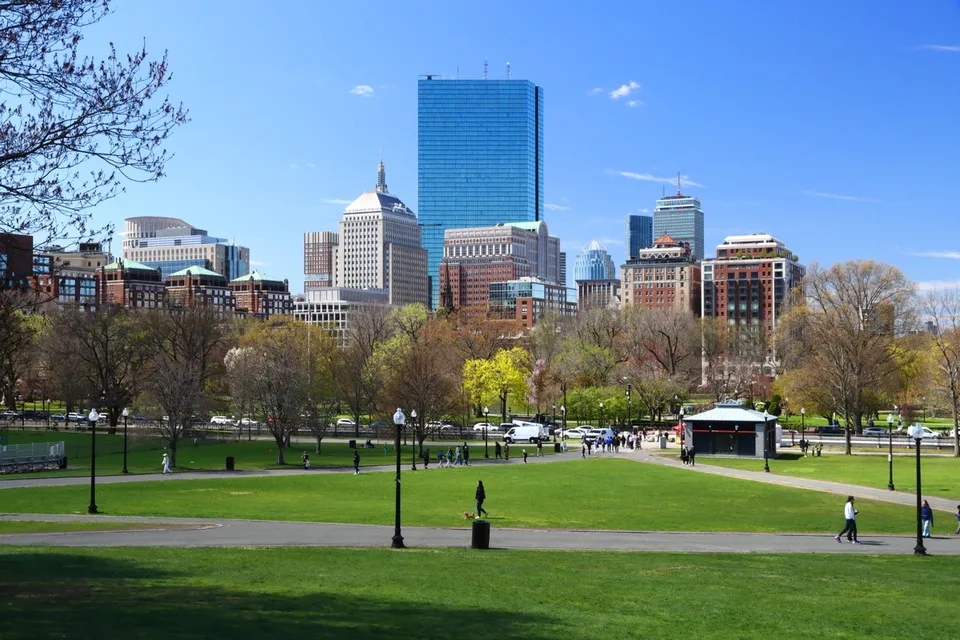
Boston Common
About
Boston Common dates from 1634, when Puritan colonists bought the land rights from William Blackstone, the first European settler on the peninsula, and the city calls it America's oldest park. For two centuries it was working ground: a pasture for the town's cows until about 1830, a militia training field, a place of public hangings and, from 1768, a camp for British troops.
It suits first-time visitors starting the Freedom Trail, families heading for the Frog Pond, and anyone who wants a free, open stretch of green between downtown and Beacon Hill. Park Street station, on the Red and Green lines, sits at the corner of Park and Tremont streets on the Common itself, and the visitor information center at 139 Tremont Street is where most walking tours begin. The Massachusetts State House faces the Common across Beacon Street, 0.2 miles or about five minutes on foot by the Freedom Trail Foundation's reckoning, and the Public Garden lies across Charles Street to the west.
Monuments worth finding
The most acclaimed is Augustus Saint-Gaudens' bronze memorial to Colonel Robert Gould Shaw and the 54th Massachusetts Regiment, opposite the State House, unveiled in 1897 to honor the first all-Black volunteer regiment in the Union army. On Flagstaff Hill, the Soldiers and Sailors Monument, dedicated in 1877, rises as a victory column, and the hill has long been a sledding slope. The Brewer Fountain, the Common's first piece of public art in 1868, is a bronze cast of a French original. The Boston Massacre Memorial of 1888 depicts Crispus Attucks, the first to fall, and The Embrace, Hank Willis Thomas's 20-foot bronze honoring Martin Luther King Jr. and Coretta Scott King, was unveiled in 2023.
The Frog Pond through the year
The Frog Pond is one of the Common's original ponds, and it changes with the seasons: a spray pool for children in summer and, for a fee, an ice rink in winter. The Skating Club of Boston runs the pond and the carousel beside it, which turns from April to October when the weather allows.
A stage for public life
The Common has been Boston's place to speak up and gather. Charles Lindbergh promoted commercial aviation here, Martin Luther King Jr. led a civil rights rally, and Pope John Paul II celebrated Mass in 1979. The Parkman Bandstand, a Greek temple dedicated in 1912, is the backdrop for the annual Shakespeare on the Common productions.
Practical notes
There is no parking on the Common itself; the Boston Common Garage sits underneath it, with its entrance on Charles Street. Public restrooms are at the visitor information center and, seasonally, at the Frog Pond. Food trucks may park at Brewer Fountain Plaza in summer, the Frog Pond café opens seasonally, and small carts sell food and drinks around the park.
Sources: City of Boston: Boston Common, Friends of the Public Garden: the Common, park FAQ, hours and directions, Freedom Trail: Boston Common. Checked September 27, 2026.
Contact Information
Boston, 02111
Photo: Te Liu via Google
Boston Common
About Boston Common
Boston Common dates from 1634, when Puritan colonists bought the land rights from William Blackstone, the first European settler on the peninsula, and the city calls it America's oldest park. For two centuries it was working ground: a pasture for the town's cows until about 1830, a militia training field, a place of public hangings and, from 1768, a camp for British troops.
It suits first-time visitors starting the Freedom Trail, families heading for the Frog Pond, and anyone who wants a free, open stretch of green between downtown and Beacon Hill. Park Street station, on the Red and Green lines, sits at the corner of Park and Tremont streets on the Common itself, and the visitor information center at 139 Tremont Street is where most walking tours begin. The Massachusetts State House faces the Common across Beacon Street, 0.2 miles or about five minutes on foot by the Freedom Trail Foundation's reckoning, and the Public Garden lies across Charles Street to the west.
Monuments worth finding
The most acclaimed is Augustus Saint-Gaudens' bronze memorial to Colonel Robert Gould Shaw and the 54th Massachusetts Regiment, opposite the State House, unveiled in 1897 to honor the first all-Black volunteer regiment in the Union army. On Flagstaff Hill, the Soldiers and Sailors Monument, dedicated in 1877, rises as a victory column, and the hill has long been a sledding slope. The Brewer Fountain, the Common's first piece of public art in 1868, is a bronze cast of a French original. The Boston Massacre Memorial of 1888 depicts Crispus Attucks, the first to fall, and The Embrace, Hank Willis Thomas's 20-foot bronze honoring Martin Luther King Jr. and Coretta Scott King, was unveiled in 2023.
The Frog Pond through the year
The Frog Pond is one of the Common's original ponds, and it changes with the seasons: a spray pool for children in summer and, for a fee, an ice rink in winter. The Skating Club of Boston runs the pond and the carousel beside it, which turns from April to October when the weather allows.
A stage for public life
The Common has been Boston's place to speak up and gather. Charles Lindbergh promoted commercial aviation here, Martin Luther King Jr. led a civil rights rally, and Pope John Paul II celebrated Mass in 1979. The Parkman Bandstand, a Greek temple dedicated in 1912, is the backdrop for the annual Shakespeare on the Common productions.
Practical notes
There is no parking on the Common itself; the Boston Common Garage sits underneath it, with its entrance on Charles Street. Public restrooms are at the visitor information center and, seasonally, at the Frog Pond. Food trucks may park at Brewer Fountain Plaza in summer, the Frog Pond café opens seasonally, and small carts sell food and drinks around the park.
Sources: City of Boston: Boston Common, Friends of the Public Garden: the Common, park FAQ, hours and directions, Freedom Trail: Boston Common. Checked September 27, 2026.