Faneuil Hall Marketplace
About
Faneuil Hall Marketplace is two things side by side, and it helps to know which is which. Faneuil Hall is the brick meeting hall and market that the merchant Peter Faneuil gave the town in the 1740s, where colonists protested the Sugar Act and the Stamp Act in 1764; the City of Boston owns it and the National Park Service runs it as a free visitor center and historic site on the Freedom Trail. The marketplace is the cluster around it: Quincy Market, opened in 1826 and named for Mayor Josiah Quincy, and the North and South Market buildings completed in 1827. After decades of decline the buildings were revived in 1976 by developer Jim Rouse, architect Benjamin Thompson and Mayor Kevin White, a project the marketplace describes as the original festival marketplace.
It suits a first visit that wants history and an easy lunch in the same stop, families who need many food choices under one roof, and a wet afternoon of browsing among more than 80 businesses. Street performers and musicians work the cobblestone promenades daily from 11 a.m. to 9 p.m. The marketplace sits between downtown and the waterfront, with State, Haymarket, Government Center and Aquarium stations all nearby, and the Freedom Trail continues from here toward the North End; the State House and Boston Common are at the trail's other end.
Inside Faneuil Hall
The Park Service visitor center fills the ground floor and lower level, with maps, exhibits and films. Upstairs, the Great Hall has hosted meetings, protests and debates for more than 275 years and still holds rallies, concerts and naturalization ceremonies. Rangers give free talks there on the building's history, and the Ancient and Honorable Artillery Company runs its own free museum on the fourth floor. Look up for the golden grasshopper weathervane by Shem Drowne. The marketplace's own history notes that much of Peter Faneuil's wealth came directly and indirectly from human enslavement.
Quincy Market's food colonnade
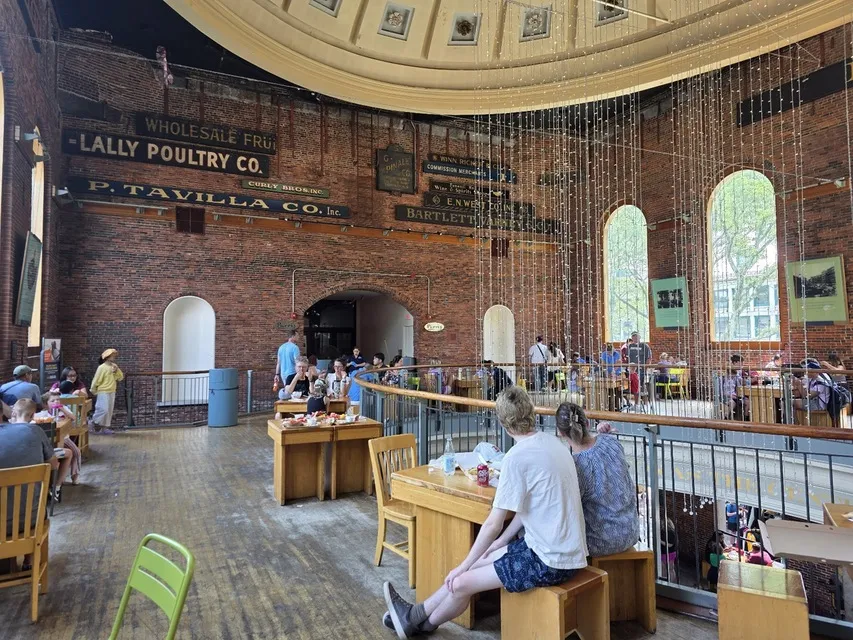
The long central hall of Quincy Market holds more than 25 local food counters; the marketplace calls it the first food hall in the United States. Expect chowder, lobster rolls and seafood from counters such as Boston Chowda and Boston & Maine Fish Company, plus pizza from Regina Pizzeria, pastry from North End Bakery, and plenty of ice cream and bubble tea. Quincy Market turned 200 in 2026. Outside, the pushcart program that began here in 1976 now has more than 40 local vendors selling gifts and apparel.
Getting there
The marketplace lists State Street and Haymarket on the Orange Line, Government Center and Haymarket on the Green Line, and Aquarium on the Blue Line as the T stops to use. Driving is possible but garages nearby charge downtown rates; the options are in the FAQ.
Restaurants and bars in the marketplace
Beyond the food counters, the marketplace buildings hold sit-down restaurants and bars. Ned Devine's Irish Pub and The Salty Dog are in the Quincy Market building. Margaritaville is in the North Market building and Sugar Factory in the South Market building.
Tree House Brewing Company, the Massachusetts brewery founded in 2011, opened at the marketplace's West End in 2026 with a patio for outdoor seating; you can bring food from the Quincy Market counters to eat there.
Sources: Faneuil Hall Marketplace, marketplace history, dining, parking and directions, National Park Service: Faneuil Hall, Boston National Historical Park, Freedom Trail: Faneuil Hall. Checked September 27, 2026.
Contact Information
Boston, 02109
Photo: Jos Rook via Google
Faneuil Hall Marketplace
About Faneuil Hall Marketplace
Faneuil Hall Marketplace is two things side by side, and it helps to know which is which. Faneuil Hall is the brick meeting hall and market that the merchant Peter Faneuil gave the town in the 1740s, where colonists protested the Sugar Act and the Stamp Act in 1764; the City of Boston owns it and the National Park Service runs it as a free visitor center and historic site on the Freedom Trail. The marketplace is the cluster around it: Quincy Market, opened in 1826 and named for Mayor Josiah Quincy, and the North and South Market buildings completed in 1827. After decades of decline the buildings were revived in 1976 by developer Jim Rouse, architect Benjamin Thompson and Mayor Kevin White, a project the marketplace describes as the original festival marketplace.
It suits a first visit that wants history and an easy lunch in the same stop, families who need many food choices under one roof, and a wet afternoon of browsing among more than 80 businesses. Street performers and musicians work the cobblestone promenades daily from 11 a.m. to 9 p.m. The marketplace sits between downtown and the waterfront, with State, Haymarket, Government Center and Aquarium stations all nearby, and the Freedom Trail continues from here toward the North End; the State House and Boston Common are at the trail's other end.
Inside Faneuil Hall
The Park Service visitor center fills the ground floor and lower level, with maps, exhibits and films. Upstairs, the Great Hall has hosted meetings, protests and debates for more than 275 years and still holds rallies, concerts and naturalization ceremonies. Rangers give free talks there on the building's history, and the Ancient and Honorable Artillery Company runs its own free museum on the fourth floor. Look up for the golden grasshopper weathervane by Shem Drowne. The marketplace's own history notes that much of Peter Faneuil's wealth came directly and indirectly from human enslavement.
Quincy Market's food colonnade
The long central hall of Quincy Market holds more than 25 local food counters; the marketplace calls it the first food hall in the United States. Expect chowder, lobster rolls and seafood from counters such as Boston Chowda and Boston & Maine Fish Company, plus pizza from Regina Pizzeria, pastry from North End Bakery, and plenty of ice cream and bubble tea. Quincy Market turned 200 in 2026. Outside, the pushcart program that began here in 1976 now has more than 40 local vendors selling gifts and apparel.
Getting there
The marketplace lists State Street and Haymarket on the Orange Line, Government Center and Haymarket on the Green Line, and Aquarium on the Blue Line as the T stops to use. Driving is possible but garages nearby charge downtown rates; the options are in the FAQ.
Restaurants and bars in the marketplace
Beyond the food counters, the marketplace buildings hold sit-down restaurants and bars. Ned Devine's Irish Pub and The Salty Dog are in the Quincy Market building. Margaritaville is in the North Market building and Sugar Factory in the South Market building.
Tree House Brewing Company, the Massachusetts brewery founded in 2011, opened at the marketplace's West End in 2026 with a patio for outdoor seating; you can bring food from the Quincy Market counters to eat there.
Sources: Faneuil Hall Marketplace, marketplace history, dining, parking and directions, National Park Service: Faneuil Hall, Boston National Historical Park, Freedom Trail: Faneuil Hall. Checked September 27, 2026.